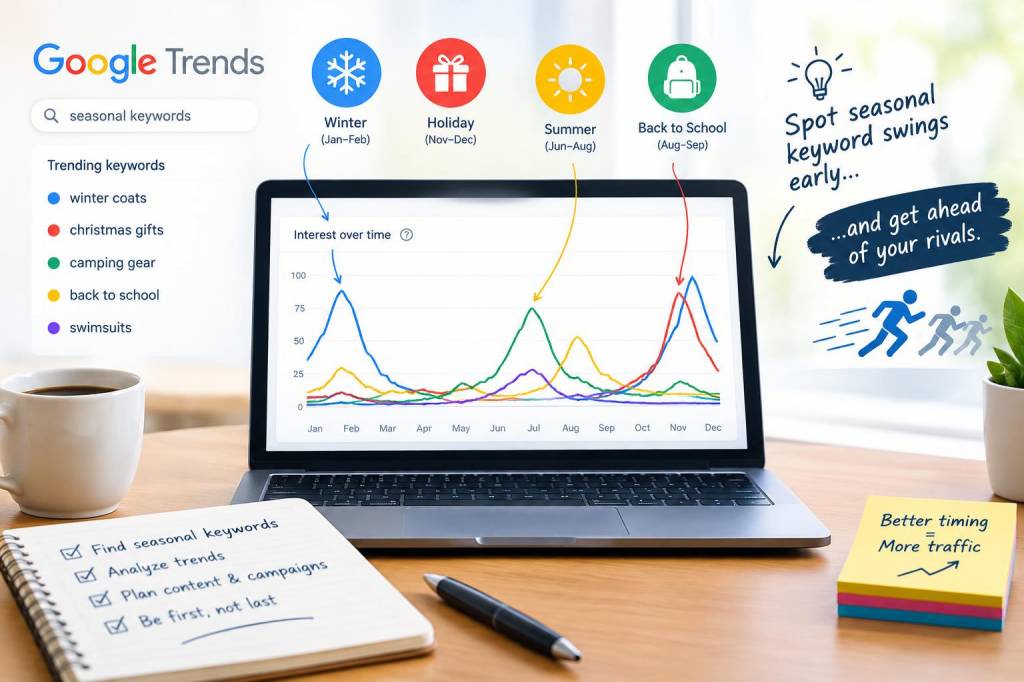
Whenever I want to understand whether demand is about to rise or fade, I start with Google Trends. I do not treat it as a curiosity tool or a place to check random search spikes. I treat it as a practical signal that can help me anticipate seasonal keyword swings before competitors notice them. That timing matters. If I can identify interest a few weeks or even a few months earlier than rivals, I can plan content, refresh pages, adjust paid campaigns, and prepare internal links before everyone else rushes in.
What I have learned is simple: seasonal search behavior is rarely completely random. It follows habits, weather, budgets, school calendars, holidays, industry cycles, and even social trends. Google Trends does not give exact search volume, but it gives something just as valuable for planning: direction. I use it to see whether a topic is growing, peaking, declining, or showing the same yearly rhythm it showed before.
What I look for first in Google Trends
When I open Google Trends, I do not begin by searching for a broad keyword and stopping there. I begin by thinking about intent. A single market can contain several related search patterns, and each one may peak at a different time. For example, “winter coat,” “rain jacket,” and “waterproof parka” may all belong to apparel, but their seasonal curves are not identical. If I only look at one phrase, I may miss the moment when demand starts shifting toward a different product or wording.
I usually check these elements first:
- Search interest over time to see whether a topic repeats every year
- Geography to find regions where interest begins earlier than elsewhere
- Related queries to discover emerging phrases before they become obvious
- Rising terms to spot breakout wording that competitors may not yet target
These checks help me move from vague curiosity to useful action. If a keyword is already obvious in my market, I do not want to be late. I want to understand where the curve is heading and whether there is a better, more timely angle that others have missed.
Reading seasonality without overreacting
I have seen many marketers make the same mistake: they spot one spike and immediately assume a trend is exploding. In reality, many searches behave like seasonal waves. A spike in November might simply reflect annual holiday demand, not a new growth story. That is why I compare several years at once. A single year can mislead me, but a multi-year pattern usually tells a clearer story.
For me, the real question is not, “Did interest rise?” It is, “Did interest rise earlier than usual, later than usual, or in a different region first?” If a keyword begins lifting in late August instead of mid-September, I know I have a planning window. If a related query starts gaining traction in one country before another, I can localize content or prioritise that market sooner.
I also pay attention to relative interest. Google Trends normalizes data, so a keyword can look smaller than expected even when demand is meaningful. That is why I never use Trends in isolation. I pair it with Search Console, keyword tools, and sometimes paid search data. Trends helps me see direction; other tools help me estimate scale.
Finding early signals in related queries
One of my favorite uses of Google Trends is exploring related queries. This is where I often discover opportunities that are still under the radar. If I search a core topic, I may find that users are gradually shifting toward a new modifier, a new product type, or a new problem they want solved. That shift can be much more valuable than the original keyword itself.
For example, if I work in e-commerce and see rising interest around a basic category, I check whether people are also searching for terms tied to convenience, portability, sustainability, or premium features. Those extra details often reveal buying intent. They also tell me what kind of content I should create: a comparison page, a buying checklist, a landing page, or an article that answers a common seasonal question.
When I spot a rising query, I ask myself three things:
- Is this phrase still underused in search results?
- Does the wording suggest a change in customer priorities?
- Can I publish or refresh something before competitors rewrite their pages?
If the answer is yes, I move quickly. Speed matters because seasonal opportunities can close fast. The first pages to match emerging demand often earn disproportionate visibility, especially when search interest peaks for only a short period.
Using geography to get ahead
Regional data has helped me spot seasonality before it became obvious in broader data. Sometimes interest grows first in one climate zone, one city, or one market segment before spreading elsewhere. That early movement is a useful warning. If I see a keyword gaining traction in a specific region, I can infer that demand may soon spread more widely.
This matters a lot for businesses with local, national, or multilingual strategies. Suppose a topic begins climbing earlier in northern regions because weather conditions change first there. I can prioritize those audiences in my content calendar, adjust landing pages, or support local campaigns before the wider market reacts. In some cases, that early focus gives me enough time to collect rankings and engagement before competitors even notice the shift.
I also use geography to avoid false assumptions. A keyword may look flat overall, but one region might already be heating up. That can be enough to justify a dedicated page, a localised update, or a short-term campaign tied to that specific audience.
Turning Trends into an editorial calendar
I do not use Google Trends as a one-time research step. I build it into my planning routine. Each time I map a seasonal topic, I decide when I should publish, refresh, or promote content. I prefer to work backward from the expected peak, because waiting until interest is already high often means arriving too late.
My editorial planning usually follows this pattern:
- Identify a seasonal topic and review its multi-year pattern
- Look for related queries that begin rising earlier than the core term
- Publish supporting content before peak interest arrives
- Update titles, intros, and internal links as demand grows
- Review performance after the peak and save findings for next year
This is where consistency matters. I keep notes on what happened last year, what changed this year, and which pages gained traction first. Over time, those notes become a personal forecasting system. I am no longer guessing when demand may return. I am comparing cycles and refining timing.
Matching content format to demand stage
Not every seasonal keyword needs the same kind of page. I have found that matching the format to the stage of demand can improve results. When a topic is still early, people often want explanation. When it is close to peak, they want action. When it is declining, they may still want comparisons, alternatives, or end-of-season deals.
That means I think about content in layers. Early interest may justify a broad explainer or planning article. Mid-cycle interest may deserve a product page, a comparison piece, or a stronger call to action. Late-cycle interest might call for a “last chance” angle, a replacement suggestion, or an archive page that still captures search demand.
This approach helps me avoid publishing the wrong asset at the wrong time. It also improves internal coordination. If my paid search, email, and organic content all support the same seasonal shift, I can make the most of the demand window instead of reacting piecemeal.
Where I see the biggest mistakes
In practice, I see a few recurring mistakes whenever people use Google Trends for seasonal planning. The first is relying on one keyword only. The second is ignoring regional differences. The third is looking at spikes without comparing multiple years. Another common mistake is treating Trends as a substitute for real search demand data. It is not a replacement; it is a signal source.
I also think people underestimate the value of query wording. Small wording changes can reveal major shifts in intent. One phrase may be informational, while another is commercial. One may signal curiosity, while another shows readiness to buy. When I see a new wording climb, I pay attention to whether the market is moving from awareness to action.
There is also a timing mistake I see often: many teams wait until the season is already visible in revenue data. By then, the search opportunity may have been visible for weeks. Google Trends gives me a way to start earlier, and that early start is often what separates a useful campaign from a rushed one.
A simple process I return to again and again
Whenever I want to spot seasonal keyword swings before rivals do, I use a repeatable process. I start with a core topic, compare several years, inspect related queries, check regional differences, and then decide what content or campaign change should happen next. I do not chase every fluctuation. I only act when I see a pattern that repeats, expands, or appears earlier than expected.
| Signal | What I infer | What I usually do |
|---|---|---|
| Earlier yearly rise | Demand is arriving sooner | Publish sooner and update existing pages |
| Regional lift | Interest is spreading unevenly | Prioritize local content or campaigns |
| Rising related query | New wording or intent is emerging | Create a fresh article or landing page |
| Repeated annual peak | Strong seasonal cycle | Plan content well before the peak |
I like this method because it is practical, not theoretical. It gives me a way to act before the market fully catches up. That early action does not guarantee rankings, of course, but it gives me a much better chance of earning them while competitors are still reacting. And in SEO, that timing advantage often makes all the difference.