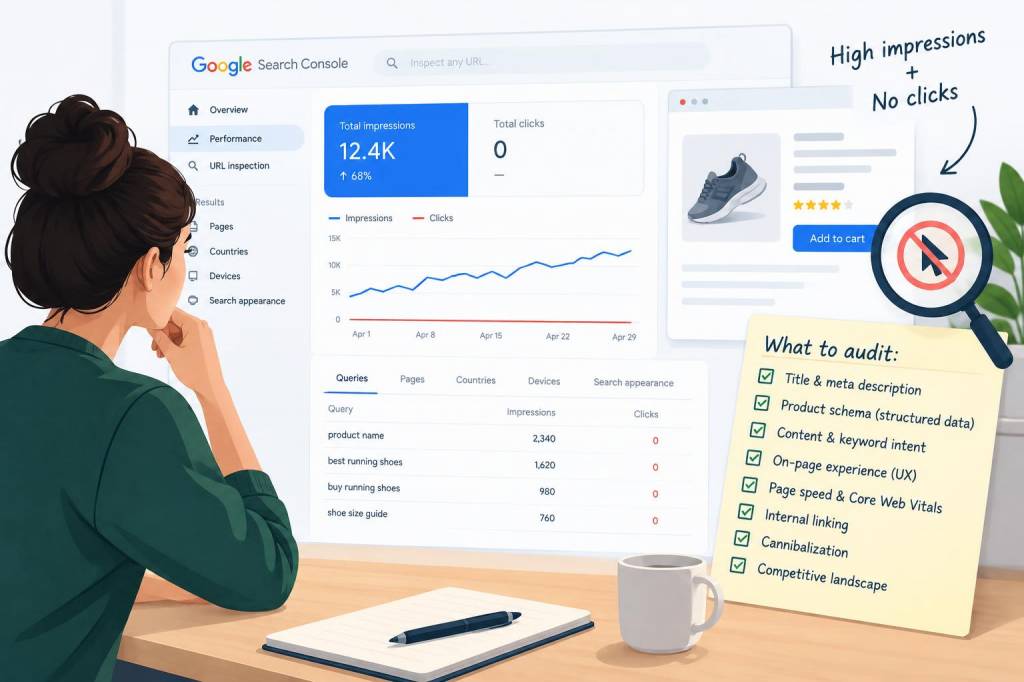
When I open Google Search Console and see product pages earning impressions but not clicks, I do not treat it as a traffic problem alone. I treat it as a signal that something in the search journey is not convincing enough, not visible enough, or not aligned enough with search intent. In my experience, impressions without clicks usually mean Google is willing to show a page, but searchers are not persuaded to choose it. That gap is where I start auditing.
I like to begin by separating visibility from appeal. A page can rank for a query, appear many times, and still fail to earn interest. For product pages, that is often more frustrating because commercial intent is already present. People are searching with purchase in mind, so if they are not clicking, something is reducing trust or relevance at a very specific point in the results page.
Search intent and query alignment
The first thing I review is whether each product page actually matches the intent behind the queries that generate impressions. I look at Search Console data by page and query, then ask myself a simple question: would I expect a shopper to click this page for this query?
Sometimes a product page appears for broad informational searches when users really want comparisons, reviews, or buying advice. In that case, impressions may be strong because Google tests the page, but clicks remain weak because searchers want a different type of result. I also see the opposite: a page ranks for a specific product name, yet the title and snippet do not clearly confirm that exact product.
My audit usually includes these checks:
- Do query terms match product names, attributes, and category language?
- Is a page being shown for broad terms it cannot satisfy well?
- Does content answer buyer concerns such as size, compatibility, shipping, warranty, or use case?
- Is another page on my site a better match for that query?
If the intent is wrong, I do not force clicks with copy alone. I either improve the page so it genuinely fits the query or I shift internal signals so Google understands a different page deserves that visibility.
Title tag and meta description
When impressions are present but clicks are not, I check title tag and meta description very early. These are often the first persuasive elements searchers see, and they have a huge impact on click behavior.
I ask whether the title is clear, specific, and distinct. A title that is too generic can blend into many similar results. A title that is too long can lose important details. A title that is too clever can hide the actual product value. For product pages, clarity usually wins.
My review focuses on whether the title includes:
- Brand and product name when relevant
- Key differentiator such as size, material, model, or version
- Use case or benefit when useful
- Natural language that mirrors search behavior
I treat the meta description as a chance to answer the unspoken question: why should I click this result? If the description is missing, duplicated, or automatically generated in a weak way, I rewrite it to be more persuasive. I prefer concise value statements over vague marketing language.
Snippet competition in the results page
I also study what else appears on the search results page. Even a solid product page can lose clicks if competitors, shopping ads, reviews, FAQs, or rich results dominate visual attention.
In practice, I compare my page against the results that surround it. I want to know whether my listing looks weaker because of:
- More compelling titles from competitors
- Visible star ratings on other results
- Price information shown elsewhere but not on my page
- Product images or shopping modules pulling attention away
- AI overviews or rich answer boxes satisfying the query before a click happens
This matters because a low click rate is not always a page weakness. Sometimes it is a search results layout issue. If a query triggers rich shopping experiences, I may need structured data, stronger merchandising copy, or a different page type to compete effectively.
Structured data and rich result eligibility
Product pages often gain much more visibility when product schema is clean and complete. I audit structured data carefully because it can influence how a page appears in search, even if it does not guarantee richer presentation every time.
My checklist includes product name, image, brand, availability, price, review markup, and any required properties that support valid product results. I also verify that the markup matches visible content. If the structured data claims something the page does not show, I treat that as a risk.
I have seen pages with impressions but very poor click performance because they lacked key rich result signals that competitors had. A product result with visible price, rating, and stock information often earns attention more easily than a plain blue link. When appropriate and compliant, I improve markup to make the result more useful and trustworthy at a glance.
Page title, hierarchy, and product clarity
Once I move beyond search appearance, I inspect the page itself. If Google is showing the page but users still are not clicking, I want to know whether the landing experience is confusing, thin, or not persuasive enough from a searcher perspective.
I review the product page for clear hierarchy. The product name should be obvious. Variants should be easy to understand. Important benefits should be near the top. If the page starts with weak branding, generic copy, or cluttered elements, users may hesitate when they see the page in search.
I ask myself whether the page communicates:
- What the product is
- Who it is for
- What makes it different
- What the user should expect after clicking
When a page is unclear, the search snippet often reflects that uncertainty. A stronger on-page structure usually supports a stronger snippet and a more confident click-through rate.
Content depth and buyer questions
For product pages, I never look only at the product name and price. I look at whether the page gives enough reasons to trust the click. Searchers often want answers before they commit. If those answers are missing, they may keep scrolling.
The questions I try to answer on product pages are often practical:
- What are the exact dimensions or specifications?
- What materials or ingredients are used?
- Is it compatible with other products or systems?
- How is it shipped, returned, or maintained?
- What makes it better than similar options?
If I notice that impressions come from comparison-style queries, I usually expand content with clear differentiators. If users are looking for premium quality, I explain craftsmanship, materials, or performance. If users care about affordability, I make price and value more visible. If they need reassurance, I add shipping, returns, and warranty details.
Internal linking and page prioritization
Another area I audit is internal linking. Google often learns which pages matter most from the way a site connects content. If multiple pages compete for similar queries, or if a product page receives weak internal support, Google may test it in search without giving it strong click appeal.
I look at whether the product page is linked from category pages, related products, editorial content, and navigation elements. I also check anchor text. If internal links use vague language, I miss a chance to reinforce relevance.
I want internal signals to be consistent. If a page is important for a certain product term, I try to use that term naturally in links, headings, and surrounding copy. That usually strengthens both understanding and discoverability.
Technical issues that quietly reduce clicks
Sometimes the page is visible in Search Console, but technical issues make it less appealing or less reliable in search. I do not ignore these, even when impressions look healthy.
The main technical checks I run are:
- Indexable canonical version is correct
- Page loads quickly on mobile
- Images render properly
- Price and availability are not stale
- Duplicate pages are not diluting signals
- Pagination or filters are not creating confusion
If product data is outdated, searchers notice. If the page is slow or unstable, Google may still show it, but users can lose trust before clicking. I also verify that no accidental noindex, canonical mismatch, or parameter issue is weakening performance behind the scenes.
Devices, countries, and brand familiarity
I like to segment impressions by device and geography because low clicks often hide patterns. A page may perform well on desktop but poorly on mobile. It may attract clicks in one country and underperform in another because language, currency, or shipping expectations are different.
Brand familiarity also matters more than many people expect. If the product is from a lesser-known brand, users may need stronger trust signals before clicking. If the brand is famous, the page may benefit from recognition. I consider whether the snippet and page reinforce trust with reviews, policies, and recognisable product naming.
A practical audit table I use
| Area | What I check | Why it matters |
|---|---|---|
| Query fit | Intent, wording, product relevance | Bad alignment lowers clicks |
| Snippet | Title, description, rich result potential | Searchers decide fast |
| Page content | Clarity, benefits, buyer answers | Support for trust and relevance |
| Structured data | Product, price, availability, reviews | Improves presentation potential |
| Internal linking | Anchor text, page priority, related links | Signals importance to search engines |
| Technical health | Indexing, speed, canonicals, freshness | Protects visibility and trust |
When I audit product pages with impressions but no clicks, I rarely find only one issue. More often, I find a combination: the query is slightly off, the title is too vague, the snippet is unconvincing, and the page itself does not answer enough buyer questions. Fixing one element can help, but the strongest gains usually come from improving several pieces together.
What I look for most is not just ranking presence, but click confidence. If I can make the search result feel relevant, useful, and trustworthy in a few seconds, I usually see movement. If I cannot, then the page may need a different query target, stronger merchandising, or a more complete content structure before it earns the attention it deserves.